
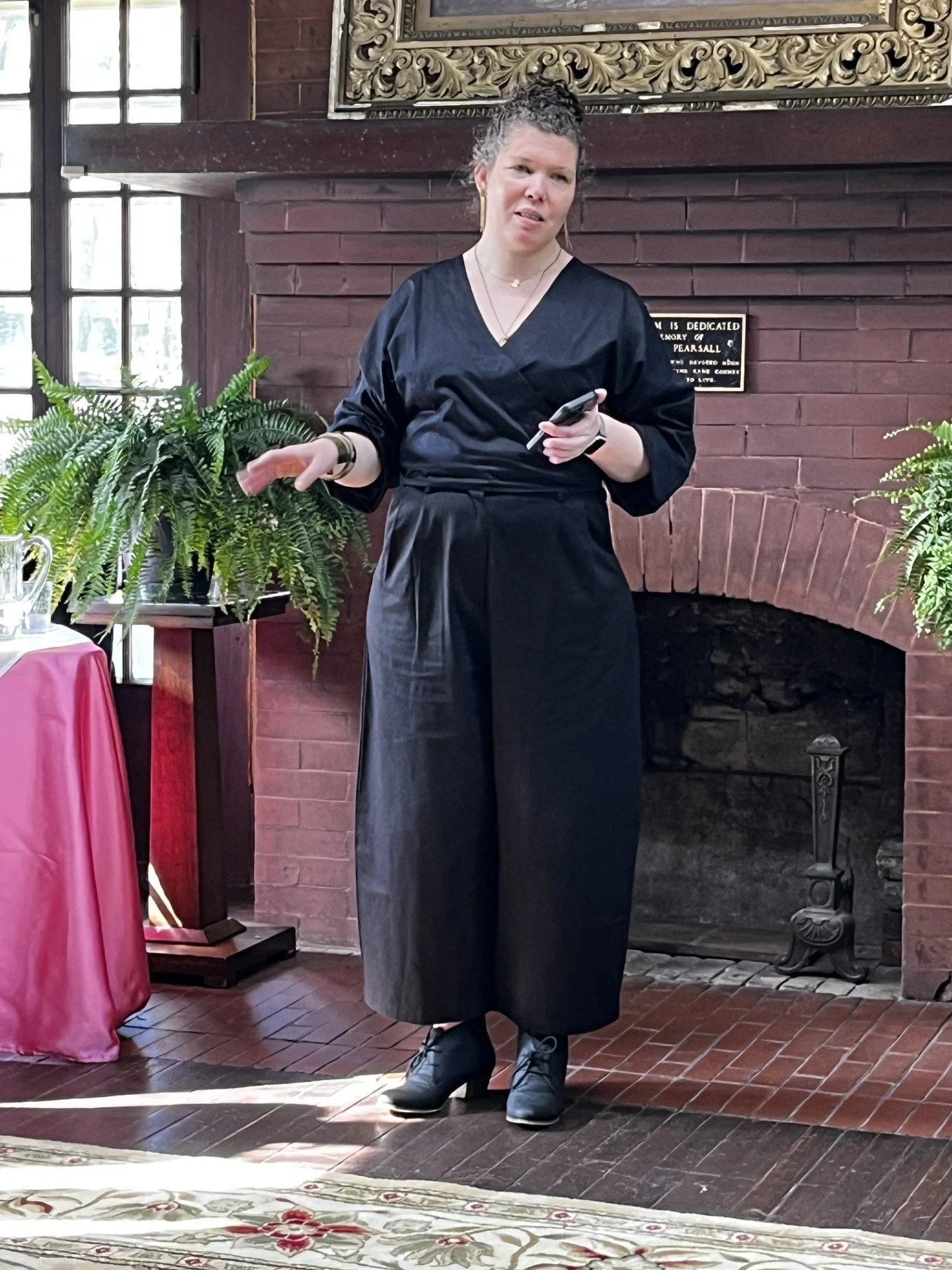
Tara Hills, lead conservator from the Conservation Center of Chicago for the restoration of Nelle Fabyan’s gown, speaking at the Exclusive First Look of the gown at the Fabyan Villa Museum on April 18, 2026. Photo by Preservation Partners of the Fox Valley.
Recently we submitted a few questions to the Conservation Center of Chicago about their work in restoring Nelle Fabyan’s Parisian Couture Gown designed by Georges Doeuillet:
1. How DID the Conservation Center of Chicago gEt involved in restoring the gown?
The gown belongs to the Fabyan Villa Museum collection and came to the Conservation Center because it was in serious need of professional attention. Even in its damaged state it was clearly an extraordinary piece: a G. Doeuillet Parisian ballgown dating to around 1910-1920 that had belonged to Nelle Fabyan. The Center was brought in to assess its condition and determine what could be done to stabilize and preserve it for display and future study.
2. What WAS the restoration process was like?
The process began with a thorough examination to understand the gown’s original construction and what had been lost or damaged over the past one hundred years. It is a sleeveless gown of rose-colored silk satin with silk and metallic thread embroidery, handmade rosettes, a strand of beadwork and rhinestones along the neckline, delicate pink silk bobbinet trim, and an attached satin train, designed by Parisian couturier Georges Doeuillet for Nelle Fabyan.
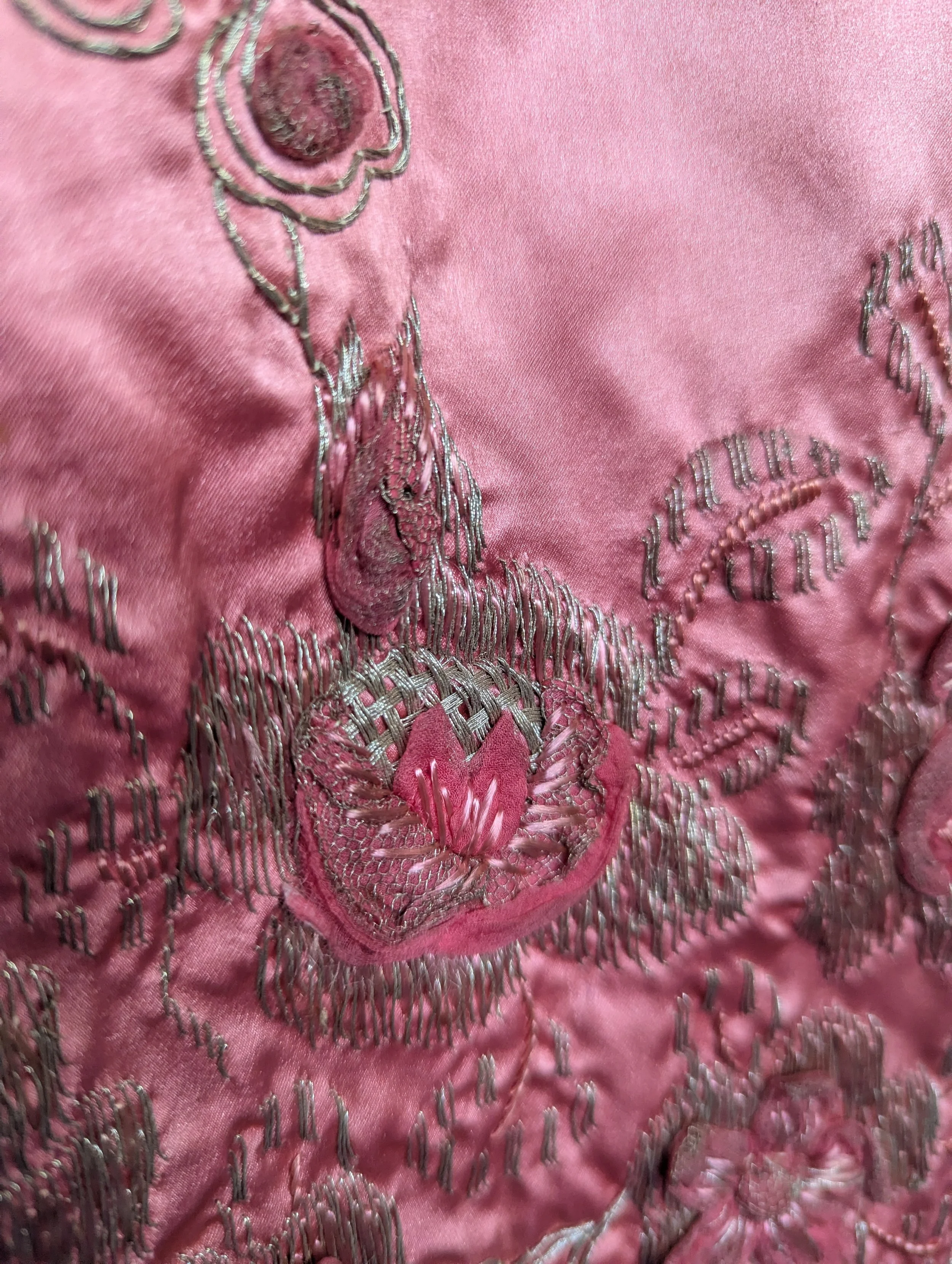
Detail of Nelle Fabyan’s Parisian Couture gown. Photo by Preservation Partners of the Fox Valley.
The dress told an interesting story about what had survived and what had not. The silk satin had held up quite well, and the silver lace along the bottom was remarkably stable. But other areas were in serious distress. The bodice lining had “shattered” which is a term we use in textile conservation to describe when silk becomes brittle and begins to separate and fall apart. Even though the lining is hidden from view, it had to be carefully restored because it supports the entire structure of the dress.
One of the most difficult decisions involved the pink bobbinet trim. After a century it had largely disintegrated, and only small fragments remained. Because the bobbinet was critical to the design of the dress, it was decided to replace it. Similar material was sourced and then hand dyed to match the original. The original fragments were then stored for future research.
3. Who was involved in the process?
The conservation work was carried out by conservators Tara Hills and Frank Connet for the Conservation Center of Chicago in collaboration with the Fabyan Villa Museum. Research into comparable garments from the period, including similar Doeuillet designs and related works in the Metropolitan Museum of Art collection, helped inform decisions about the dress’s original design, particularly the bobbinet’s likely role as a floating decorative element anchored by two small silver florets.
4. How long did the conservation work take?
The work took several months. A dress like this has many layers, literally and figuratively, and addressing each one responsibly takes considerable time. Every decision had to be made carefully, balancing what was necessary now against what future conservators might want to do.
5. Anything else the conservators would like to share?
“It wasn’t just a dress, it was a performance.”
What makes this dress remarkable is not just its maker. G. Doeuillet was one of the leading Parisian couture houses of the early 20th century, and this gown is a perfect example of a transition moment in fashion between World War I and the Roaring Twenties. It was also designed to be experienced in motion. Based on the surviving silver florets and comparable garments of the period, it appears the bobbinet was designed to hang in long, loose wisps from the shoulders or back of the dress, floating freely as the wearer moved. Imagine being at a ball and watching Nelle Fabyan dance, that pale pink silk mesh catching the air around her.
It wasn’t just a dress, it was a performance.
After a hundred years, through all the damage and loss, that intention is still readable in the construction. The dress still speaks to Nelle Fabyan, to Parisian couture, and to a very specific moment in time.
Nelle Fabyan’s Parisian Couture Gown is now on display at the Fabyan Villa Museum at 1925 S. Batavia in Geneva, Illinois on Wednesdays, Saturdays, and Sundays 11am-3pm from May through September. For tickets, visit www.ppfv.org/fabyan-villa-musuem.
Learn more about famed Parisian fashion designer Georges Doeuillet here: https://www.ppfv.org/blog/georges-doeuillet-french-couturier.
Thank you for reading! If this story interested, inspired, or informed you, please consider subscribing to our monthly e-newsletter so more of these stories come right to you!